



How to make roasted chicken stock like a pro starts with mastering the fundamentals of a French kitchen. As a classically trained chef, I'll show you how roasting chicken bones unlocks deeper flavor, then transforms them with mirepoix and aromatics into a rich, gelatinous foundation for classic mother sauces.
Save This Recipe!
I always save bones to make chicken stock, which I show in my guide, How To Break Down A Whole Chicken, which can be reduced down into a Chicken Demi-Glace.
A properly made stock is the foundation of culinary arts, and the reason restaurant sauces taste so good. That same technique applies to Veal Stock, which can be reduced into a rich Demi-Glace, like the one I use for my Red Wine Braised Short Ribs.
Jump to:
- Chicken Stock Video
- What is Chicken Stock?
- Chicken Stock vs Chicken Broth
- Why Homemade Chicken Stock is Better Than Store-Bought
- Chicken Stock Rules (and the mistakes That Ruin it)
- Ingredients & Substitutions
- How To Make Chicken Stock (Step-By-Step Instructions)
- How To Strain, Store, and Cool Chicken Stock
- Recipe FAQ's
- Ways to use Chicken Stock
- More Stock Recipes
- 📖 Recipe
- 💬 Comments
Chicken Stock Video
What is Chicken Stock?
Chicken stock is made from chicken bones (back, neck, and feet), vegetables (mirepoix), seasoning (aromatics), and cold water.
There are two types of chicken stock, white stock and brown stock, and the only difference is that brown stock roasts and caramelizes the bones in a hot oven.
The stock is slowly simmered over a low heat for 4 hours, strained, cooled down quickly, and then properly stored.
Chicken Stock vs Chicken Broth
Chicken Stock: Is made from bones, mirepoix (celery, carrots, and onions), and aromatics (garlic, bay leaves, peppercorns, fresh thyme, and parsley stems), and water.
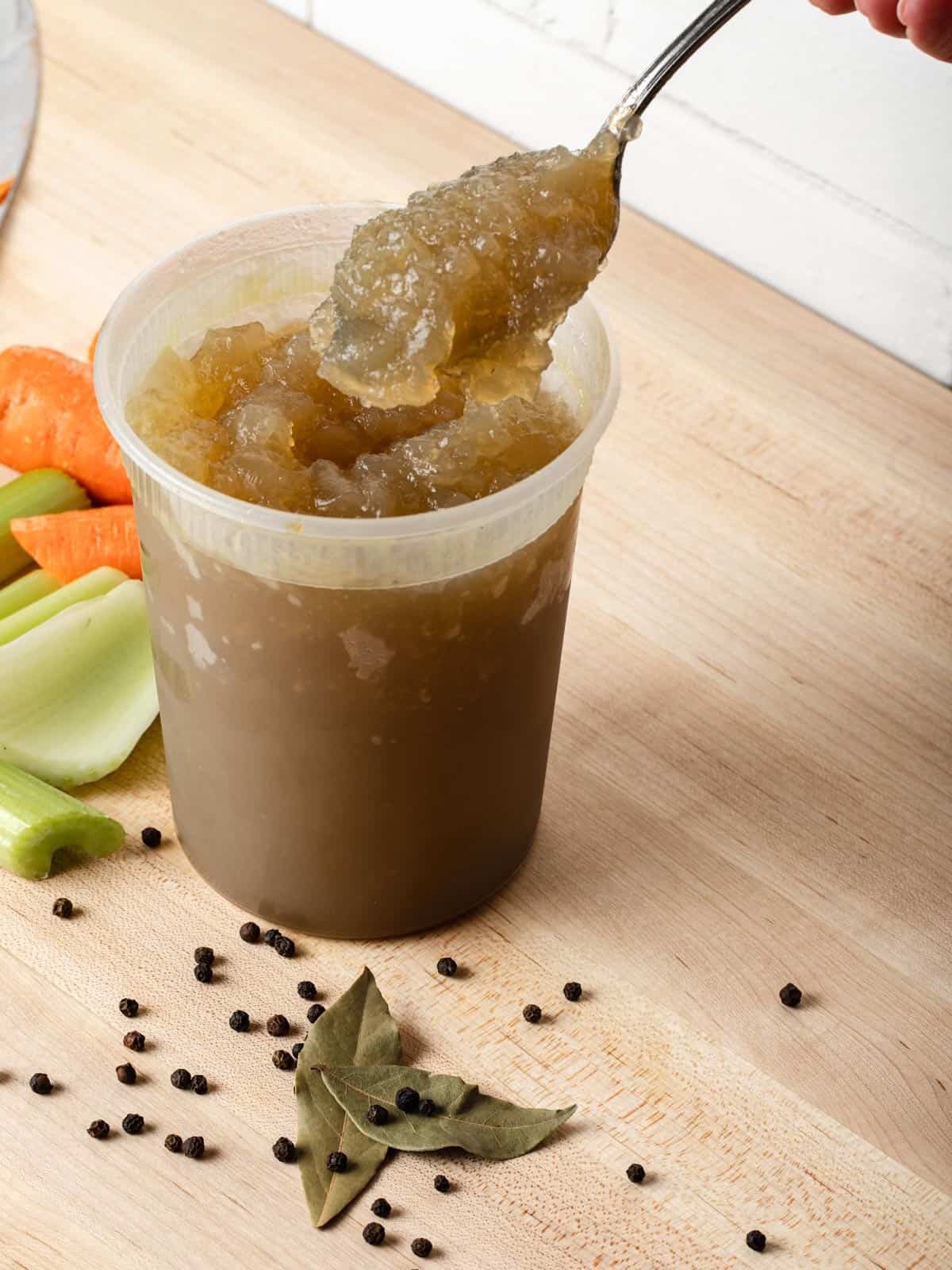
It's simmered for many hours using collagen-rich bones, which results in a gelatinous stock.
Chicken Broth: Is made from meat, vegetables, aromatics, and salt. Simmered for a few hours and has a thinner consistency.
Why Homemade Chicken Stock is Better Than Store-Bought
- Chicken Bones. A mixture of collagen-rich chicken backs, necks, and feet creates a gelatinous stock.
- Box broth can't compete. It uses ingredients like salt, sugar, and not enough bones.
- Great for sauce making. When a stock is reduced, it transforms into a restaurant-quality sauce.
Chicken Stock Rules (and the mistakes That Ruin it)
- Start with cold water: The transition from cold to hot water coagulates proteins and impurities, causing them to rise to the surface for easy skimming. Starting with hot water will result in a cloudy stock.
- Simmer, don't boil: Bring the liquid just to a boil, then immediately reduce to a low simmer. A rapid boil emulsifies fats and impurities into the liquid, permanently clouding the stock.
- Skim the surface often: Periodically skim the "scum" that rises to the top to maintain a clean stock.
- Strain carefully: For the clearest results, pour the stock through a fine-mesh strainer (chinois) lined with cheesecloth.
Ingredients & Substitutions
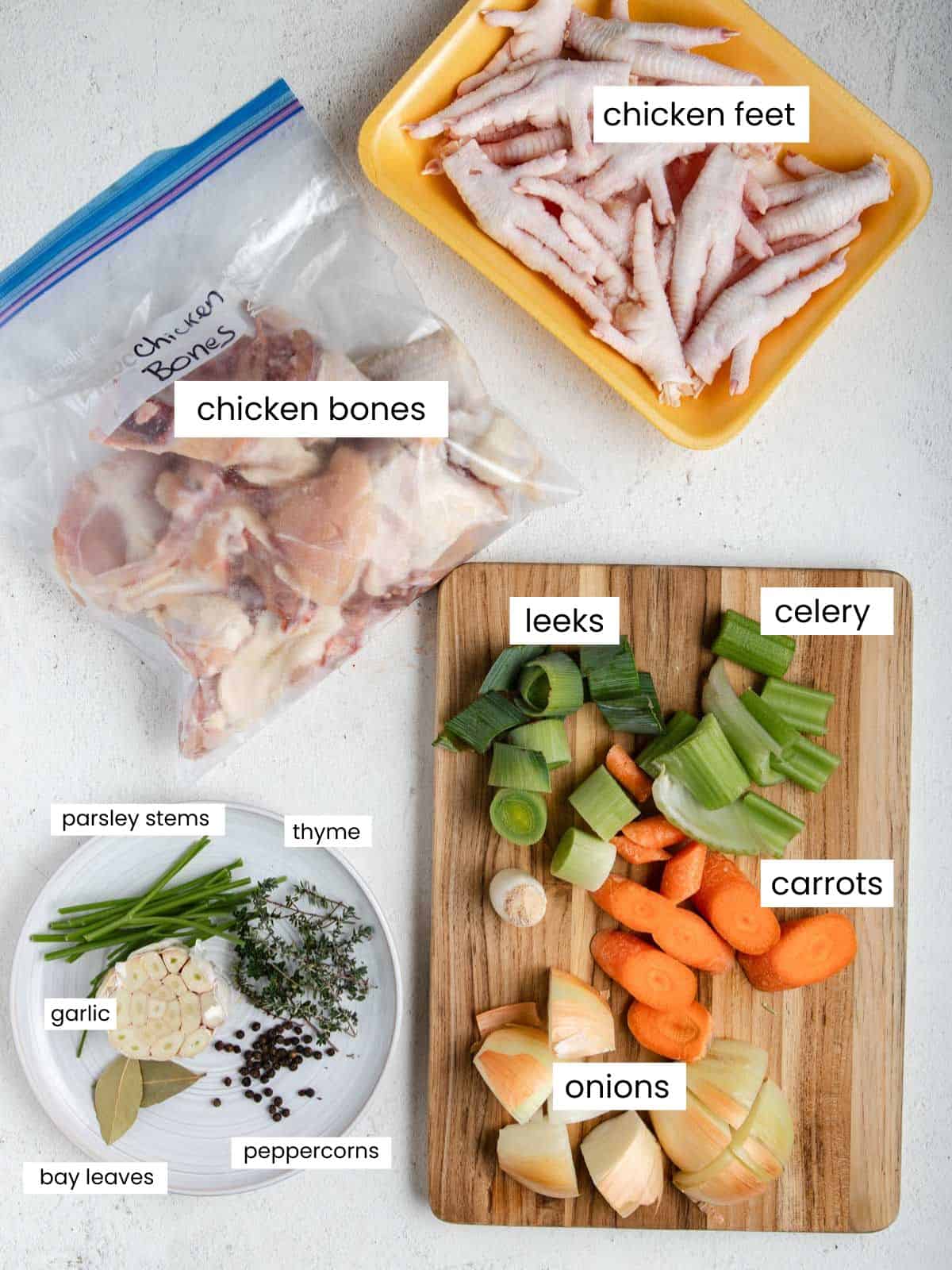
- Chicken Bones - A combination of chicken back, necks, and feet is used for a gelatinous stock.
- Mirepoix - The ratio is 50% onions, 25% carrots, and 25% celery. Oftentimes, chefs will add leeks to their stocks as well.
- Aromatics - Are known as seasoning in stock and consist of garlic, bay leaves, peppercorns, parsley stems, and fresh thyme.
- Water - Only use cold water in stock making.
See recipe card for quantities.
How To Make Chicken Stock (Step-By-Step Instructions)
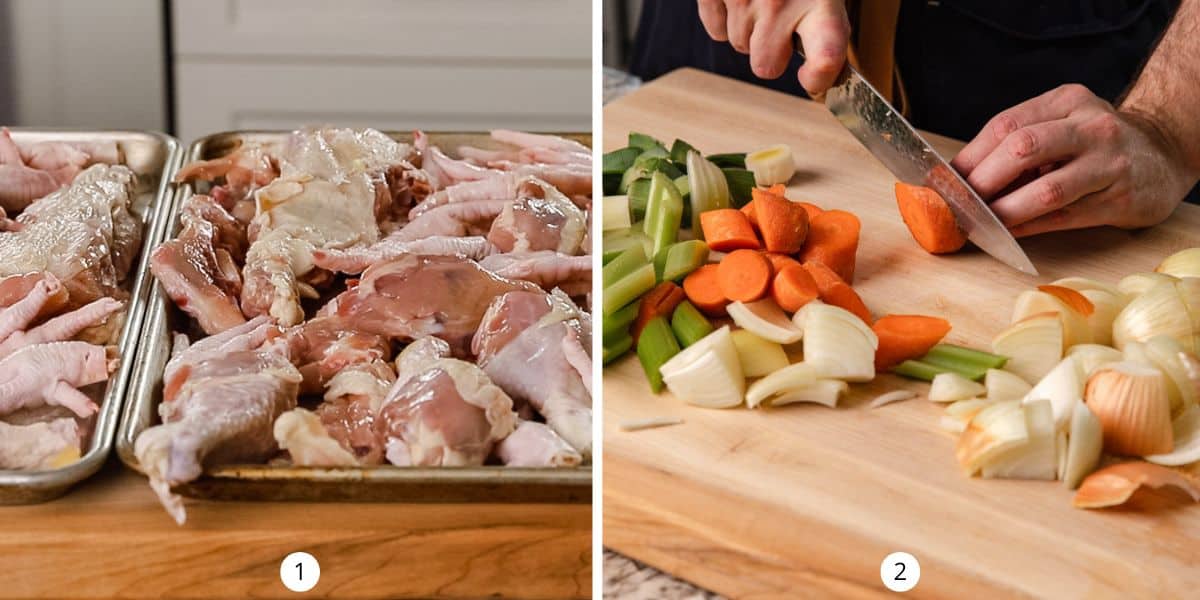
Step 1. Place the chicken bones on a sheet pan (no parchment paper today), spray with cooking spray, and roast in a 425°F (220°C) oven for 1 hour or until golden brown.
Step 2. While the bones are roasting, it's time to prep our mirepoix (carrots, celery, and onions) into a large dice. For more information on knife cuts, check out my Knife Skills 101 resource.
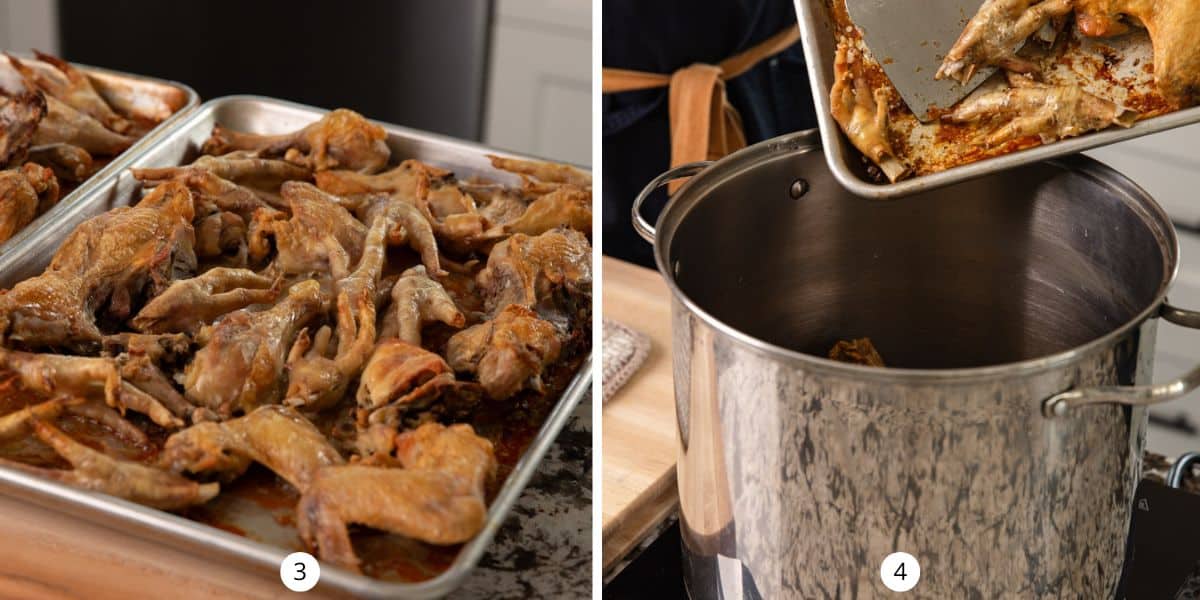
Step 3. Transfer the roasted chicken bones into a large stock pot.
Step 4. Put the sheet pan back on the heat, add a cup of water, and scrape with a spatula to deglaze, transferring the liquid over the bones in the stock pot.
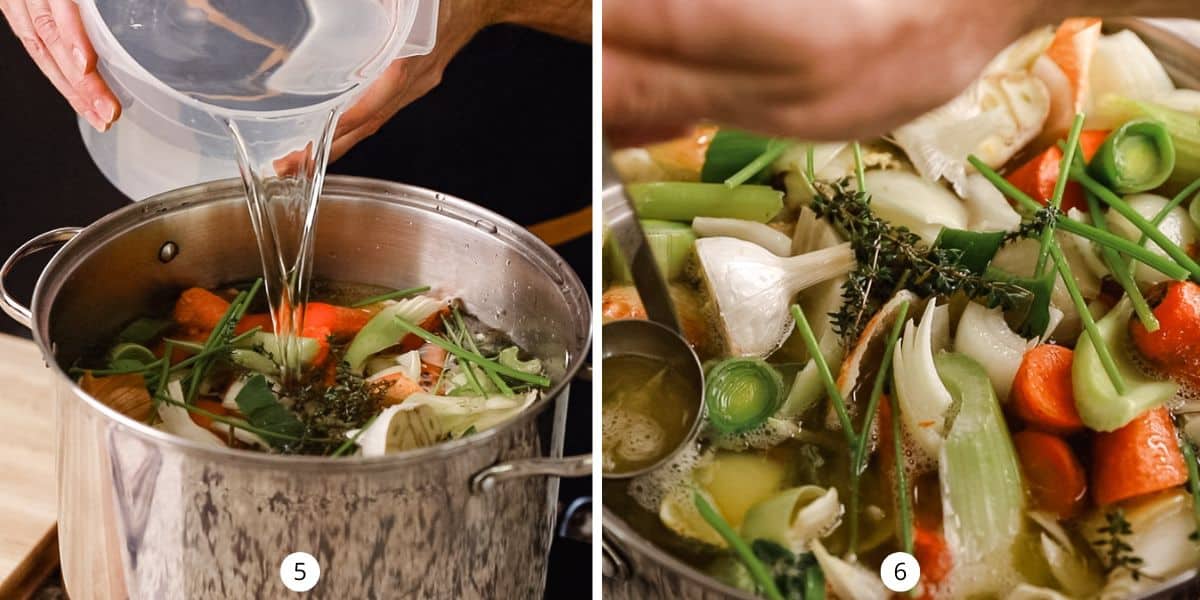
Step 5. Add the mirepoix, aromatics, and cover the bones with 2-3 inches of cold water.
Step 6. Bring the stock up to a boil, reduce the heat to a simmer, and skim the fat and impurities that rise to the surface. Cook over a slow simmer for 4 hours.
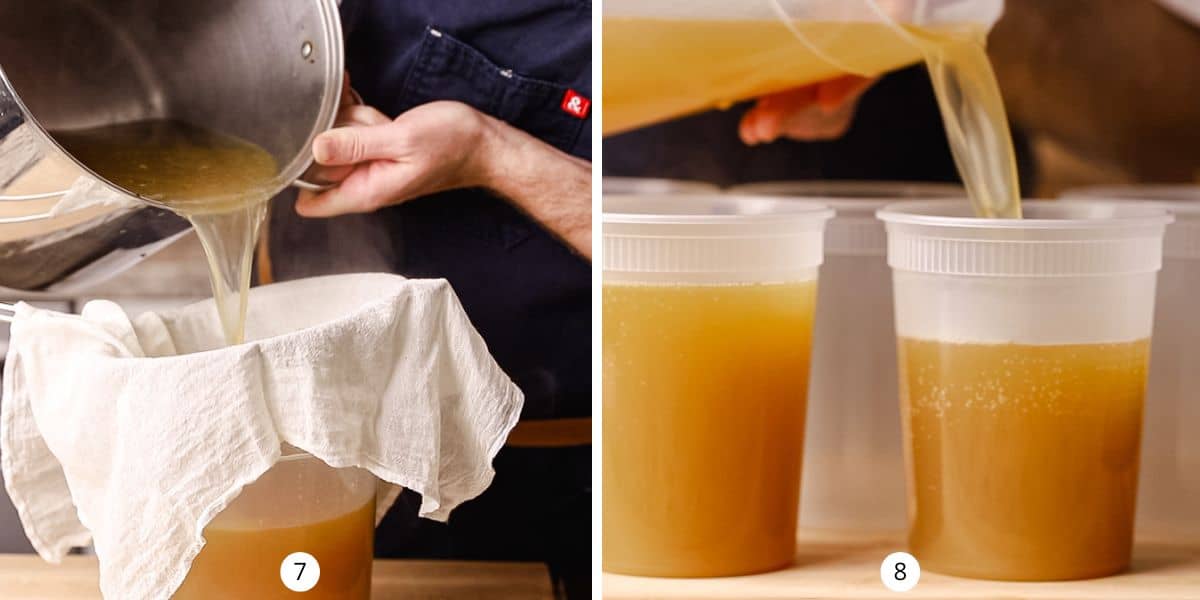
Step 7. Using a spider or slotted spoon, remove the large bones and vegetables. Set a fine-mesh sieve lined with cheesecloth (optional) over a bowl or container, and pour the stock through.
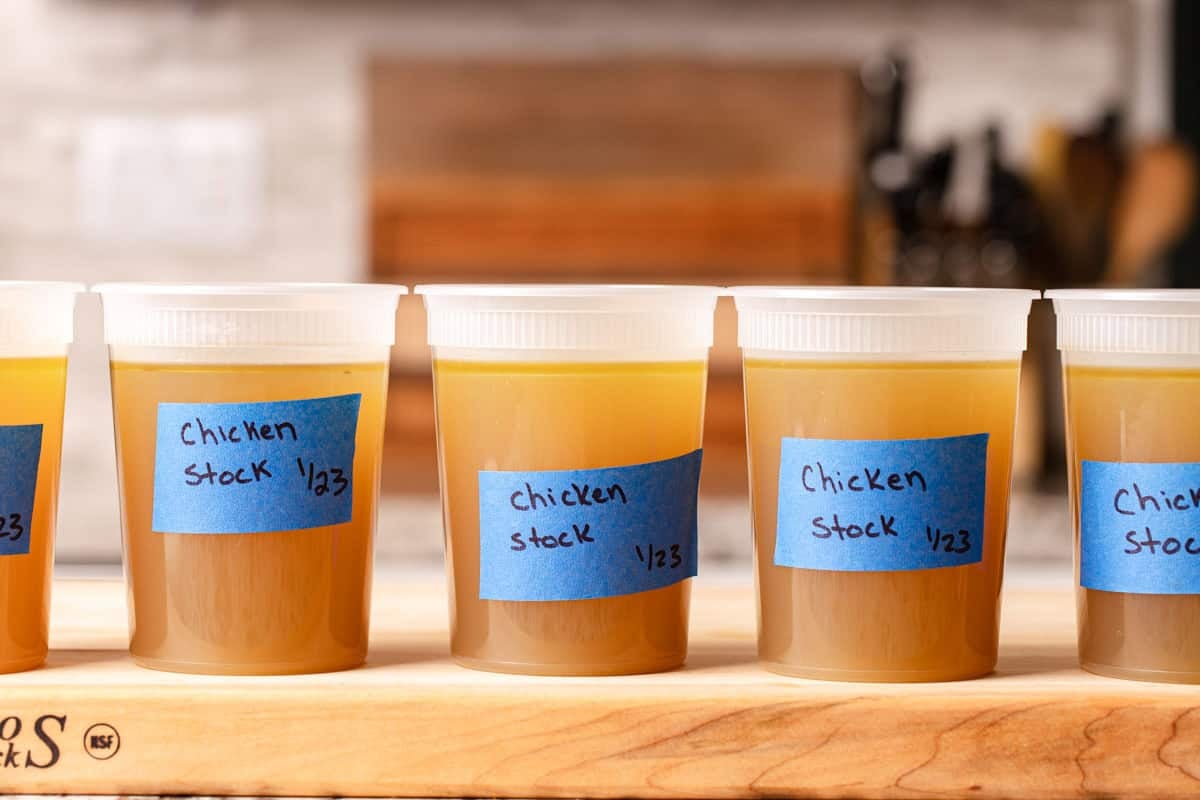
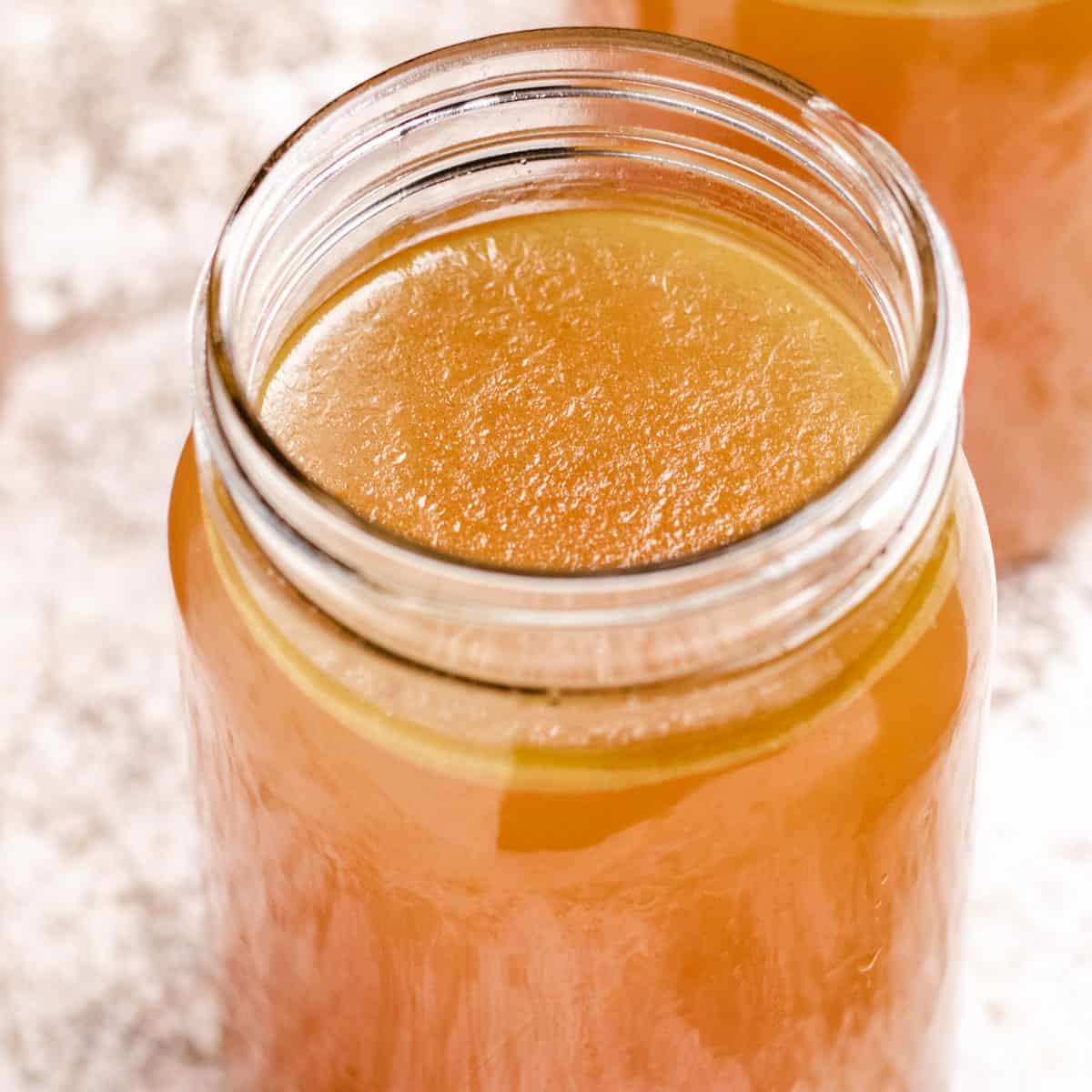
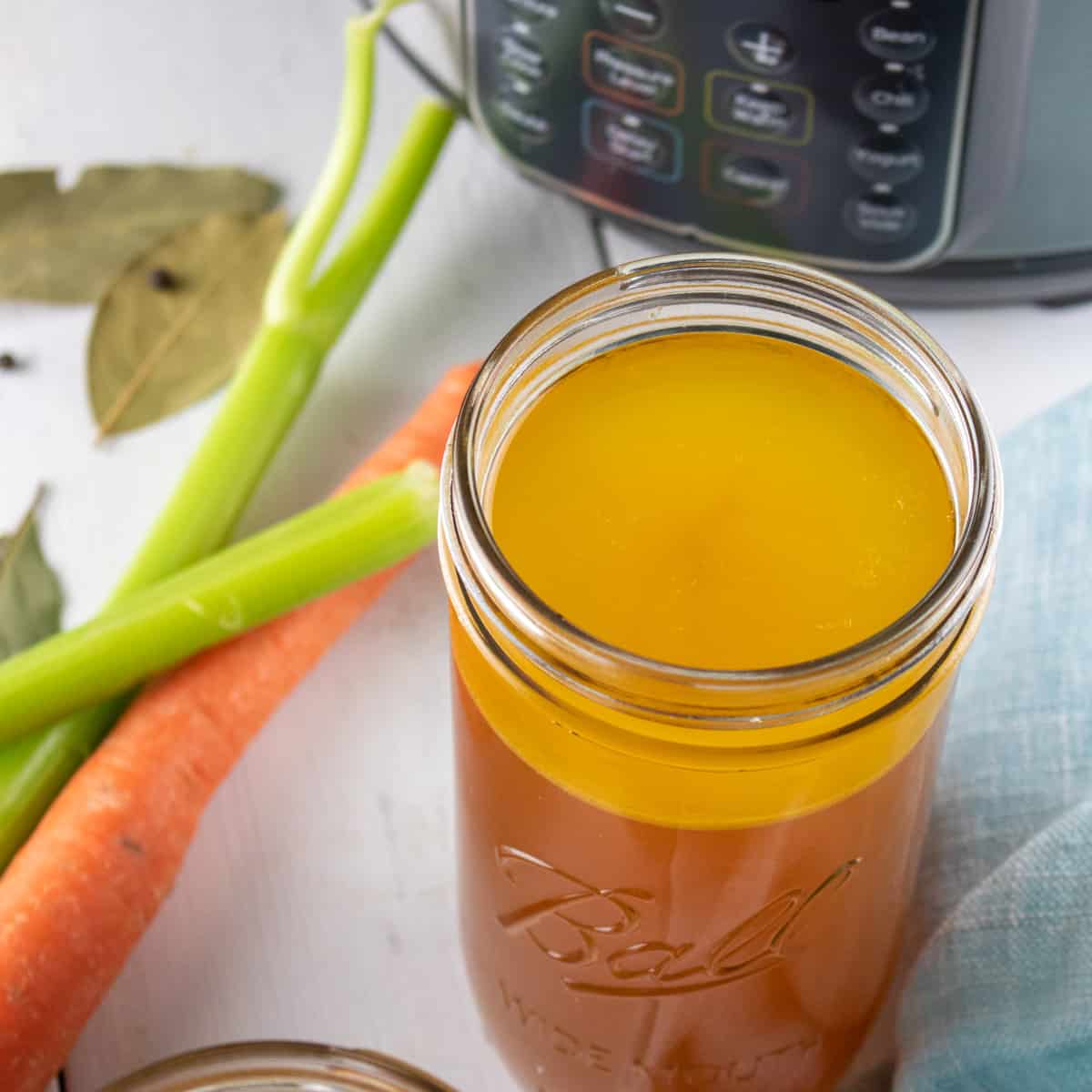
Step 8. Transfer the chicken stock into freezer-safe quart containers or glass mason jars.
How To Strain, Store, and Cool Chicken Stock
Strain: I like to strain my stock through a fine-mesh strainer lined with cheesecloth into a large bowl. Then I portion it into quart containers.
Cooling: Set up an ice bath in your kitchen sink using ice and water. The ice bath should come up a few inches around your quart containers so they stay upright and don't tip over. Place the containers in the ice bath and cool the stock until the internal temperature reaches 40°F (4°C).
Freeze: Leave 1-2 inches of space at the top of the container to allow for expansion during freezing. Secure the lid and freeze for up to 2-3 months.
Recipe FAQ's
Your stock didn't gel because you didn't use enough bones (1 pound of bones for 1-2 quarts of water). Adding in a couple of pounds of chicken feet yields a gelatinous stock.
Yes, it's called a remouillage, and it's a great way to get a second batch of chicken stock from your bones. Place the saved bones in a stockpot, add fresh vegetables and aromatics, and cover with water.
Chicken stock only needs to simmer for 4-5 hours. Any longer, and you risk extracting bitter flavors from the bones and aromatics.
It depends. Do you want a clear stock for soups or poaching chicken, or a deeper, more concentrated flavor for pan sauces?
Ways to use Chicken Stock
Chicken stock is so versatile in the kitchen and can be seen in main dish recipes such as Shrimp Scampi without Wine, and soups like my Turkey Lentil Soup and Zuppa Toscana Soup.
More Stock Recipes
If you tried this Chicken Stock Recipe or any other homemade stock recipe on my website, please leave a 🌟 star rating and let me know how it went in the 📝 comments below. I love hearing from you!
📖 Recipe
Roasted Chicken Stock Recipe
Ingredients
- 8 pounds chicken carcasses
- 2 pounds chicken feet
- 2 gallons cold water
- 1 cup onions roughly cut
- ½ cup celery roughly cut
- ½ cup carrots roughly cut
- 1 bulb of garlic
- 2 bay leaves
- 1 teaspoon black peppercorns
- 1 sprig of thyme
- parsley stems
Instructions
- Place your chicken bones and chicken feet on a sheet pan and spray with oil, then roast at 425°F (220°C) for 45 minutes or until golden brown.
- Transfer the roasted bones to a large stock pot and deglaze your pan with a small amount of water to get all of the fond. Transfer that to the large pot.
- Now we are going to add our mirepoix (onions, celery, and carrots) to our stock pot and pour in 2 gallons of cold water. Add in your aromatics (garlic, bay leaves, thyme, parsley, and peppercorns).
- Bring your stock up to boil, then reduce the heat to a simmer and skim the impurities off the top. Let it simmer for 4 hours.
- Remove the bones using a spider or slotted spoon and transfer to a large bowl. Then, pour stock through a fine mesh strainer and portion into mason jar or quart containers.
Notes
Chicken Stock Rules
- Start with cold water: The transition from cold to hot water coagulates proteins and impurities, causing them to rise to the surface for easy skimming. Starting with hot water will result in a cloudy stock.
- Simmer, don't boil: Bring the liquid just to a boil, then immediately reduce to a low simmer. A rapid boil emulsifies fats and impurities into the liquid, permanently clouding the stock.
- Skim the surface often: Periodically skim the "scum" that rises to the top to maintain a clean stock.
- Strain carefully: For the clearest results, pour the stock through a fine-mesh strainer (chinois) lined with cheesecloth.


Mike Cleavenger says
Learning how to make chicken stock will make everything taste better!